Your MacBook Used to Last All Day. What Changed?
You unplug your MacBook in the morning feeling completely confident. A few hours later, the battery icon is already looking nervous. You close a couple of tabs, quit an app, lower the brightness — and somehow the percentage keeps falling.
It is frustrating because the MacBook still looks perfectly healthy. The screen is bright, everything opens quickly, and nothing seems obviously wrong. Yet the battery feels like it has quietly become part of your daily schedule.
The good news? Fast battery drain does not always mean your battery is dying. Sometimes your Mac is simply working harder than you realise.
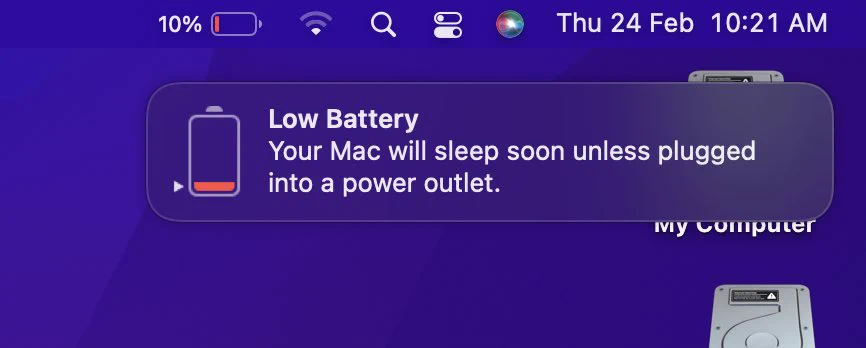
Before buying a replacement battery: take a quick look at what your Mac is actually doing. One demanding app, a background process, or a workload that keeps the Mac awake can make a perfectly serviceable battery feel dramatically worse.
Why Does My MacBook Battery Drain So Quickly?
Battery life is not determined by the battery alone. Your Mac is constantly balancing display brightness, processor activity, graphics work, connected devices, background apps, network activity and the way you use it.
A video call, dozens of browser tabs, photo editing, external displays or a demanding creative app can all change the picture. Sometimes the culprit is an app you opened hours ago and forgot about. Sometimes it is a process that keeps working after the window itself has disappeared.
That is why “my battery is draining fast” is not really a diagnosis. It is a symptom. The useful question is much more interesting: what is making my Mac work so hard?
Check Battery Health Before You Blame the Battery
Your Mac already keeps an eye on battery health. In System Settings → Battery, you can check the battery health information available for your Mac. On supported models, macOS can also show whether service is recommended.
You can also check the battery’s cycle count in System Information. A cycle is not simply one trip from 100% to 0%; it represents the equivalent of using the full battery capacity over time. Battery cycle limits vary by Mac model, so the number only makes sense when you compare it with your specific Mac.
In other words, seeing a few hundred cycles does not automatically mean “my battery is finished.” Context matters.
What Does “Service Recommended” Mean?
If macOS shows a battery warning such as Service Recommended, do not simply hide it and hope for the best. It can indicate that the battery’s ability to hold charge has declined enough that service may be appropriate.
At the same time, a battery warning and ordinary fast drain are not the same thing. If your battery health looks normal but the charge disappears unusually quickly, the next step is to investigate energy use rather than immediately assume the hardware has failed.
Find the Apps Quietly Drinking Your Battery
Activity Monitor has an entire Energy view for this. It can show the relative energy impact of individual apps and processes, along with information such as whether an app is preventing sleep.
That is where things get interesting. You may discover that the app you thought was “closed” is still busy, or that one small utility is quietly keeping your Mac awake. Once you know the name, optimization becomes much less mysterious.
Optimized Battery Charging Is Your Friend
Your Mac does not need to be treated like a fragile glass object. Modern macOS includes battery features designed to reduce wear over time.
Optimized Battery Charging can learn your charging routine and delay charging past 80% in situations where your Mac expects to remain connected to power. On Mac computers with Apple silicon running macOS Tahoe 26.4 or later, you may also have a Charge Limit setting.
It is a small change, but over months and years, small changes are exactly what help a battery age more gracefully.
What Can You Do to Make Your MacBook Last Longer?
None of this is about squeezing every last minute out of your Mac at the expense of actually enjoying it. Good optimization should feel almost invisible. Your Mac should simply stop wasting energy where it does not need to.
Let Your Mac Show You What’s Happening
If you want a quick Terminal check, the command below asks macOS to report the current battery status. It is deliberately simple and read-only: it does not change your power settings, alter your battery, or “repair” anything behind your back.
It gives you a clean snapshot of the battery percentage, charging state and related information available through macOS’s power-management interface.
Now follow these three simple steps.
Copy the Command
Click the button below to copy the command. It only reads your Mac’s current battery status — it does not change anything.
pmset -g batt
Paste into Terminal
Open Terminal from Applications → Utilities, then paste the command using:
⌘ Command + V
You do not need to understand every line Terminal prints. Think of it as asking your Mac a very direct question: “What is my battery doing right now?”
Press Enter
Press Enter ↵ and read the short report that appears.
What This Command Actually Does
pmset is macOS’s built-in power-management utility. With the
-g batt option, it reports battery information rather than changing any
power-management settings.
The Best Battery Optimization Is the Kind You Feel, Not the Kind You See
Imagine leaving home with your MacBook at 100% and not immediately starting the mental calculation: “How long do I have left?”
You open your laptop in a café. Work for a while. Move to another room. Take it to a meeting. Open it again on the train. The battery percentage is still comfortably there, instead of flashing through your mind every time you unplug.
That is what good optimization should feel like: less babysitting, more freedom.
Sometimes the improvement comes from a single power-hungry app. Sometimes from background activity, settings, charging habits or a workload that is heavier than you realised. And sometimes the battery itself has simply reached the point where service is the sensible answer.
Give Your MacBook Its Breathing Room Back
You do not need to become a battery expert to get more from your Mac. You need to know where the energy is going, remove the unnecessary strain, and leave the parts of macOS that already know how to manage themselves alone.
That is where thoughtful Mac optimization makes a difference. Instead of throwing random “battery saver” tricks at the problem, you look at the machine as a whole: what launches, what keeps running, what uses energy, how the Mac sleeps, how it charges, and whether the battery itself is still in good shape.
The result is not a MacBook that merely survives longer. It is a MacBook that feels easier to live with.
Still Losing Battery Faster Than You Should?
If your battery health looks normal but the percentage keeps falling far too quickly, there may be more going on in the background. If you see a service warning, the battery has a high cycle count, or your Mac behaves differently after an update, a proper check can save you from hours of trial and error.
You should not have to spend your day hunting through settings just to make your MacBook last through the afternoon. Let the optimization work happen quietly in the background — and get back to using your Mac for the things you actually bought it for.